


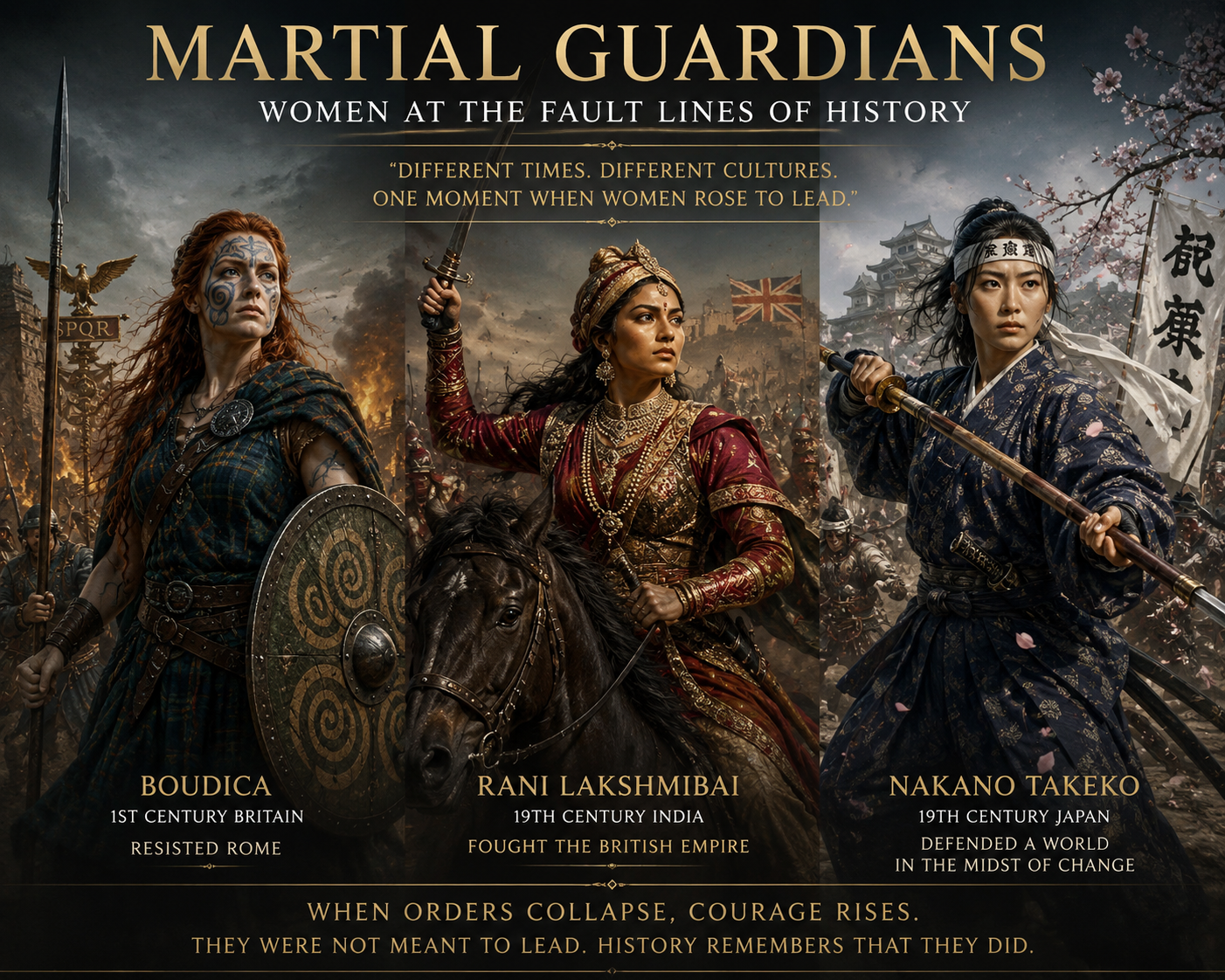
Martial Guardians
They lived in vastly different eras and cultures, yet their stories converge on a common theme: the moment when an established order collapses and women assume roles that society had never intended for them.
At first glance, the lives of Boudica, Rani Lakshmibai, and Nakano Takeko appear to have little in common. The first was a Celtic queen in first-century Britain, the second an Indian princess during the age of the British Empire, and the third the daughter of a samurai family in nineteenth-century Japan. Nevertheless, they share a striking historical parallel. Each became a symbol of resistance against an overwhelmingly powerful political and military threat.
Boudica rose against Rome. After the Romans annexed her kingdom and humiliated her clan, she led one of the greatest uprisings in ancient British history. Her rebellion was crushed by Rome’s military superiority, yet collective memory transformed her into an enduring embodiment of the struggle for freedom against a usurping power.
Almost eighteen centuries later, Rani Lakshmibai faced a remarkably similar challenge. The British Crown sought control over the princely state of Jhansi. During the Indian Rebellion of 1857, the Rani distinguished herself as a military leader. Like Boudica, she fought against an empire that was technologically, organizationally, and economically superior. And like Boudica, she died in battle, attaining a form of immortality through legend and national memory.
Nakano Takeko was neither a queen nor the leader of a nationwide rebellion. She was an onna-bugeisha (女武芸者), a woman trained in the use of the naginata. During periods when men were absent because of military campaigns, onna-bugeisha were expected to defend home and household. Tomoe Gozen represented the legendary archetype of the martial guardian who, in a moment of historical crisis, transcends conventional social boundaries by fighting in open warfare before returning to the expected sphere of female modesty. Although Tomoe Gozen is said to have fought as a female samurai during a twelfth-century conflict, it was during the Edo period that she was elevated into an iconic cultural figure.
Nakano Takeko emerged during the civil war of 1868. The so-called Boshin War marked Japan’s transition from feudalism to the modern nation-state.
Since the early seventeenth century, the Tokugawa Shogunate (1603–1867) had been the dominant force in a realm largely isolated from the outside world, while the emperor remained little more than a nominal sovereign. In 1853, Commodore Matthew Perry forced the opening of Japanese ports, providing one of the most notorious examples of American gunboat diplomacy. This intrusion divided an already pressured elite. Supporters of the shogunate considered reforms within the existing order, while the politically marginalized emperor sensed an opportunity. He sought to restore genuine authority to the imperial throne.
When Nakano Takeko was born, Emperor Kōmei (1846–1867) occupied the Chrysanthemum Throne. He was succeeded by Emperor Mutsuhito, who became the symbolic figurehead of the Meiji Restoration. In 1867, Shogun Tokugawa Yoshinobu resigned, though he did not abandon his political ambitions. The emperor’s proposals proved unacceptable to him, and the conflict escalated. Troops from the domains of Satsuma and Chōshū, known collectively as the Kangun (官軍, “Imperial Army”), fought in the emperor’s name and were equipped with modern Western weaponry. They were joined by restorationist patriots, the Ishin Shishi (維新志士), and advocates of the slogan Sonnō jōi (尊王攘夷) — “Revere the Emperor, Expel the Barbarians.”
The Meiji Restoration was fundamentally progressive. Allow me a brief digression. A Japanese knight regarded a Japanese peasant as little more his equal than a Japanese dog. The nationalization of society across all social strata only began after Japan was forced to open itself to the world. The homogenization of the population was followed by the introduction of a modern constitutional order inspired in part by European legal traditions, including the spirit of the Napoleonic Code. A civil code, the Minpō, emerged. Whereas other monarchies often slowed the pace of reform, Mutsuhito — who ascended the throne in 1867 at the age of fourteen, moved the imperial residence from the ancient capital of Kyoto to Edo, and opened political space for a Western-oriented elite — accelerated modernization in order to avoid foreign domination. For the first time in Japanese history, under his father’s reign, an invasion had not been completely repelled.
Observing China’s decline, Western powers assumed that Japan could be humiliated in the same manner as other Asian states.
In record time, a medieval military state connected itself to the global future. Speed became a matter of national survival. Industrialization provided the resources for military modernization. Japan’s strategists rejoiced: the next time an American gunboat appeared, it would be met with weapons built using the foreigners’ own knowledge.
By 1900, Japan had become a feudal society concealed beneath the attire of modernity. Traditional hierarchy merged with nationalism inside the barracks. In 1945, the Imperial Japanese Navy was sunk and a new pacifist order imposed. Article 9 of the Japanese Constitution formally renounced war and prohibited the maintenance of armed forces. In practice, however, the Self-Defense Forces established in the 1950s have preserved the possibility of Japan’s military re-emergence.
Returning to Nakano Takeko: the banners of the Kangun advanced relentlessly, carrying with them the spirit of a new age. Against them, she defended a world already slipping into history. As the foundations of the old samurai code crumbled around her, she remained faithful to the values that had shaped her life: loyalty to the Tokugawa, duty, and honor.
Nakano Takeko led a group of female fighters that later became known as the Jōshitai. The last supporters of the shogunate fled to Hokkaidō, where they briefly established an independent republic.
These women were more than warriors; they were tragic protagonists standing at the fault lines of historical transformation. The crucial observation is that it was only chaos that created the space in which women could break through patriarchal boundaries. Boudica, Rani Lakshmibai, and Nakano Takeko did not rise because their societies embraced female leadership. They rose because the normal structures of power had failed. In moments of existential crisis, necessity overruled convention.
Their stories therefore reveal a paradox. The same upheavals that destroyed kingdoms, empires, and social orders also created opportunities that would otherwise have been unimaginable. In the end, each woman fought for a cause that was defeated. Yet precisely because they stood at the intersection of resistance, sacrifice, and historical change, they survived in memory long after the worlds they defended had vanished.
 MENU
MENU