

Turning Danger into Performance – The Structural Unrest of Universal Systems
“The Catholic Church in North America is the strongest among the Western churches. The United States has more or less taken over Europe’s role as the leading force of the Church. The countries that were traditionally important for the Church – France, Spain, Germany, Poland, Ireland – appear only as shadows compared to the significance of the American Church.” Martin Mosebach
The Catholic Church is strong in the United States because it grew through massive waves of immigration, built a vast institutional network, and today plays a decisive role as a politicized swing-voter group. The fact that there have only been two Catholic presidents (John F. Kennedy in 1960 and Joe Biden in 2020) is due to the deeply rooted historical anti-Catholicism of the Protestant founding culture.
Millions of Irish, Italians, Poles, and Germans brought their Catholic faith in the 19th and 20th centuries. Ongoing immigration from Latin America (Hispanics) continues to stabilize and expand membership today. With over 70 million members, Catholicism forms the largest single religious community in North America. Protestant churches, by contrast, are fragmented into many denominations.
White, traditional Catholics often vote Republican; Hispanic Catholics often vote Democratic. Because they mirror the country’s social divide so precisely, Catholic voters in swing states often decide presidential elections.
Irish immigrants early on dominated the hierarchy (bishops, cardinals) and shaped U.S. Catholicism. Italian and Polish immigrants in the 19th and 20th centuries often felt dominated by the Irish. To avoid conflict, ethnic groups built separate churches within the same neighborhoods.
The Carroll Family – Catholic Founding Fathers
Although Catholics were legally discriminated against in almost all colonies, the wealthiest family of the Revolutionary era came from this group: Charles Carroll was the only Catholic signer of the Declaration of Independence in 1776. As the wealthiest man in the colonies, he risked the most financially for the Revolution and died in 1832 as the last surviving Founding Father.
Daniel Carroll was one of the few signers of the U.S. Constitution. John Carroll became the first Catholic bishop in the United States and founded Georgetown University, the oldest Catholic elite university in the country.
Without Catholic support, the United States in its present form would likely not exist. The military founding myth is inseparable from the Kingdoms of France and Spain. Only with the money, soldiers, and navy of Catholic great powers were the American colonists able to win the war against Protestant Great Britain.
Catholicism in North America is a historical paradox. While the founding myths are deeply Protestant and the nation has produced only two Catholic presidents to date, Roman Catholicism is the largest single denomination in the country. Mosebach captures a radical shift: the gravitational center of Western Catholicism is no longer in Europe but on the other side of the Atlantic.
The real transformation into a demographic power began in the 19th century and unfolded in a state of rupture. The Great Famine in Ireland from 1845 and political unrest in continental Europe sent millions of Irish, German, and later Italian and Polish immigrants to the U.S. East Coast.
Mass immigration triggered a violent reaction in Protestant America: nativism. Political movements such as the Know-Nothing Party in the mid-19th century agitated against alleged Vatican “foreign infiltration.” Churches were burned, violent riots broke out in cities like Philadelphia and Louisville, and discrimination in the labor market was widespread (“No Irish Need Apply”).
In response, Catholics under Irish bishops built a vast parallel society. Because public schools were Protestant in character, the Church founded the largest private school system in the world, complemented by elite universities (such as Notre Dame and Georgetown), hospitals, and orphanages. This enormous institutional infrastructure became the foundation of the American Church’s global leadership today.
While U.S. Catholics had to assert themselves under pressure, Canada—especially Quebec—was firmly rooted in Catholicism from the beginning. Even after the British conquest of 1763, the victorious crown recognized that it could not strip French settlers of their religion. The Quebec Act of 1774 secured religious freedom and tithes for Canadian Catholics.
The Kennedy Trauma – Entry into the Center of Power
Although Catholics rose economically and socially in the early 20th century, the political top remained glass-barred. When Democrat Al Smith ran as the first Catholic presidential candidate in 1928, he became the target of an unprecedented smear campaign; Protestants warned of a “subjugation of the United States to the papacy,” and Smith lost decisively.
Only 32 years later, in 1960, John F. Kennedy became the first Catholic president.
Mosebach’s observation initially appears as a minor footnote in the history of political religion. Europe declines, America rises. But it points to something more fundamental: the structural unrest of universal systems.
Catholicism was never tied to a single place. It is a wandering universalism: a form that remains stable only when it shifts geographically. Once a center becomes too fixed, it begins to generate its own inertia—and the energy moves elsewhere.
In this sense, America’s rise is not a victory over Europe but a circulation of form itself. Europe becomes the historical sediment of the faith, while America reactivates it in an expansive state—under contemporary conditions: demography, institutions, identity politics. What matters is not that the center shifts, but that a center exists at all. Every centralization produces its own periphery—and every periphery eventually develops the capacity to read itself as a new center.
Strength is structurally paradoxical. It is based on import, conflict, and institutionalization under pressure. Catholicism functions as infrastructure against a hostile majority culture. Schools, hospitals, universities: faith becomes not only religious practice but a parallel society as a survival form.
The Liturgical Repetition
The Naive Perspective III – How we have interpreted Bataille for decades
Bataille, Laure, and the Patriarchal Script of Transgression
The famous church scene in the orbit of Georges Bataille and Colette Peignot, known as Laure, is still considered one of the most radical gestures of literary and existential transgression of the 20th century. Sex in sacred space, desecration of the altar, attack on religion, morality, and bourgeois order—the scene is usually read as the culmination of a transgression that seeks not merely to violate prohibition, but to reveal a truth within the violation itself.
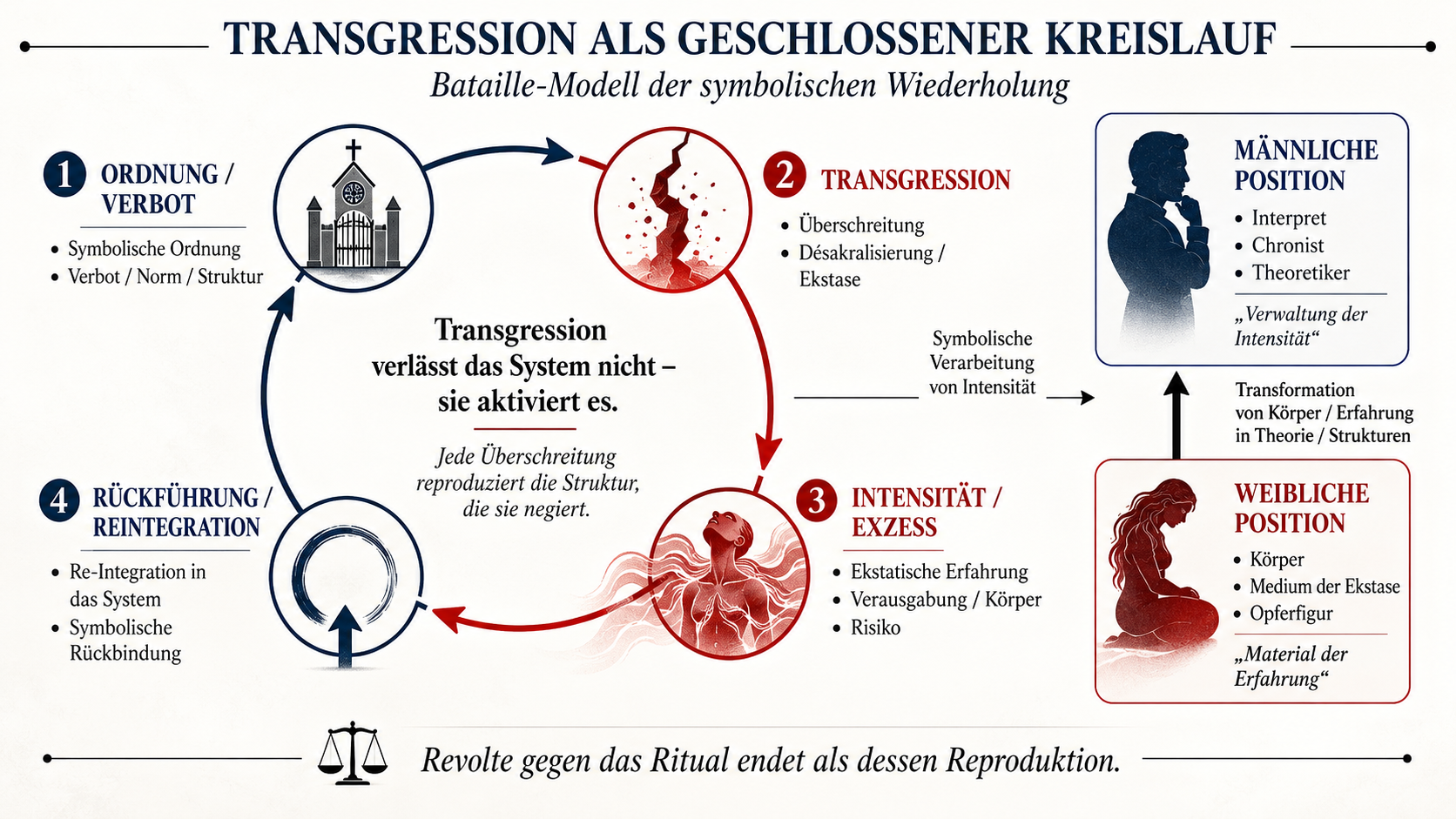
But what if the scene represents less the destruction of a symbolic order than its unconscious repetition? What if the actors believe they are breaking the ritual while in fact reenacting its oldest structure?
Bataille saw himself as an opponent of bourgeois rational order. Against functional modernity he set ecstasy, expenditure, eroticism, sacrifice, and sacrality without clerical meaning. Together with Laure he sought experiences beyond rationalized life. The secret society Acéphale, the nocturnal meetings in the forest of Saint-Germain, the obsessive engagement with Nietzsche—all aimed at destabilizing modern subjectivity.
Yet the structure of this destabilization remains strikingly familiar. At its center is again the same constellation: the priest, the altar, the desecration, the female body, the sacred transgression.
The scene claims to destroy the Christian symbolic system but remains entirely within its grammar. This is its paradox. Transgression can never fully leave the order it seeks to surpass, because it draws its energy from it. It remains bound to the structure it attempts to break.
The ambiguity goes further. Transgression appears not only as repetition of religious forms but also as reproduction of patriarchal role distribution. The woman assumes the function of sacrifice—as medium of intensity, as body upon which transgression is enacted. The man, by contrast, often remains interpreter and chronicler.
The modern patriarch no longer necessarily appears as an authoritarian ruler. He can be avant-garde, anti-bourgeois, philosophical, and transgressive. He speaks of liberation, intensity, and boundary experience—and still remains the one who administers the symbolic order of experience.
Bataille embodies this paradoxical figure in an emblematic way. The librarian of the Bibliothèque nationale, the archivist of knowledge, writes about expenditure, sacrifice, and ecstasy. While the women around him embody illness, social vulnerability, psychic exhaustion, and bodily extremity, he transforms these intensities into theory.
Not coincidentally, the scene with Laure appears both radical and schematic. The participants undoubtedly experience it as existential truth. Yet structurally it resembles an ancient script. What is disturbing is not desecration itself, but the realization that the supposed revolt unfolds entirely within the symbolic order it seeks to destroy.
Here the sophistication of power becomes visible.
Patriarchy does not disappear in moments of sexual or cultural liberation. It changes its language. It becomes aesthetic, philosophical, psychoanalytic, avant-garde. Power is exercised through ornament. The man no longer appears as tyrant but as curator of female intensity. This explains the continuity of Bataille’s avant-garde in European cinema. The woman appears as a projection surface of existential truth, while the order of representation remains male.
This is why the phonetic proximity between Laure and Laura is so suggestive. It invites speculation. Between Laure and Laura Antonelli runs an invisible line. In both cases, female intensity is aesthetically framed, philosophically charged, and simultaneously organized within a male-controlled symbolic order.
The tragedy of transgression lies in its success. It achieves precisely the intensity it seeks—while inadvertently reproducing the oldest forms of sacred and patriarchal dramaturgy.
Revolt against ritual ends as its repetition.
 MENU
MENU